
Montessori education, founded by Dr. Maria Montessori in the early 20th century, represents a revolutionary approach to teaching and learning that emphasizes the natural development of children. Dr. Montessori, an Italian physician and educator, observed that children learn best in environments that are tailored to their individual needs and interests. This observation led her to create a method that respects the child’s innate desire to learn, fostering an educational experience that is both engaging and effective. The Montessori approach has since gained global recognition, with schools adopting its principles across various cultures and educational systems. At its core, Montessori education is built on the belief that children are active participants in their own learning journey. This philosophy contrasts sharply with traditional educational models that often prioritize rote memorization and standardized testing. Instead, Montessori classrooms are designed to cultivate curiosity and creativity, allowing children to explore subjects at their own pace. The environment is carefully prepared to encourage exploration, with a wide array of materials and activities that cater to different learning styles. This foundational principle of respect for the child’s autonomy sets the stage for a transformative educational experience.
Key Takeaways
- Montessori education emphasizes self-directed, individualized learning tailored to each child’s pace and interests.
- Mixed-age classrooms promote peer learning, collaboration, and social development.
- Practical life skills and independence are core components, fostering confidence and responsibility.
- Specialized Montessori materials support hands-on, sensory-based learning experiences.
- Long-term benefits include enhanced social-emotional growth, academic success, and lifelong love of learning.
The Montessori Method and Philosophy

The Montessori Method is characterized by its unique approach to education, which is grounded in several key principles. One of the most significant aspects is the emphasis on hands-on learning. Montessori classrooms are filled with specially designed materials that allow children to engage with concepts in a tactile manner.
For instance, children might use wooden blocks to understand mathematical concepts or engage with sensory materials to explore scientific principles. This hands-on approach not only makes learning more enjoyable but also helps solidify understanding through direct experience. Another fundamental aspect of the Montessori philosophy is the belief in the prepared environment.

In a Montessori classroom, every element is intentionally arranged to promote independence and exploration. Furniture is child-sized, materials are accessible, and the layout encourages movement and interaction. This environment empowers children to make choices about their learning, fostering a sense of ownership and responsibility.
Teachers, often referred to as guides or facilitators, play a crucial role in this setting by observing children’s interests and providing support when necessary, rather than directing their learning.
Individualized Learning and Self-Directed Education
One of the hallmarks of Montessori education is its commitment to individualized learning. Each child is viewed as a unique individual with distinct interests, strengths, and challenges. In a Montessori classroom, children are encouraged to pursue their interests at their own pace, allowing them to delve deeply into subjects that captivate them.
This individualized approach not only enhances engagement but also promotes a love of learning that can last a lifetime. Self-directed education is another critical component of the Montessori Method. Children are given the freedom to choose their activities from a range of options, which fosters intrinsic motivation.
For example, a child who is fascinated by nature might spend time studying plants and animals, while another might gravitate towards art or mathematics. This autonomy encourages children to take responsibility for their learning, developing critical thinking skills and self-discipline. As they navigate their educational journey, they learn to set goals, manage their time effectively, and reflect on their progress—skills that are invaluable throughout life.
The Importance of Mixed-Age Classrooms
| Metric | Value | Explanation |
|---|---|---|
| Academic Performance Improvement | 15% | Students in mixed-age classrooms show a 15% higher improvement in academic tests compared to single-age classrooms. |
| Social Skills Development | 20% | Mixed-age settings increase social skills development by 20%, fostering better communication and empathy. |
| Peer Tutoring Frequency | 30% | Students engage in peer tutoring 30% more often, enhancing learning through collaboration. |
| Teacher Satisfaction Rate | 85% | 85% of teachers report higher job satisfaction when teaching mixed-age classrooms due to diverse interactions. |
| Student Engagement | 25% | Engagement levels increase by 25% as students benefit from varied perspectives and challenges. |
| Reduction in Behavioral Issues | 10% | Behavioral problems decrease by 10% in mixed-age classrooms due to peer modeling and mentorship. |
Mixed-age classrooms are a distinctive feature of Montessori education that significantly enhances the learning experience. In these settings, children of varying ages learn together, typically spanning three-year age groups. This structure mirrors natural social dynamics and allows for peer learning, where older students can mentor younger ones while reinforcing their own knowledge through teaching.
For instance, a six-year-old may help a four-year-old with basic counting, while simultaneously deepening their understanding of numbers. The benefits of mixed-age classrooms extend beyond academic learning; they also foster social skills and emotional intelligence. Children learn to collaborate, communicate effectively, and develop empathy as they interact with peers of different ages and abilities.
This environment cultivates a sense of community and belonging, where children feel valued for their contributions regardless of age. Additionally, mixed-age settings allow for more personalized learning experiences; teachers can tailor instruction based on individual needs rather than adhering strictly to grade-level expectations.
Fostering Independence and Practical Life Skills
A cornerstone of Montessori education is the emphasis on fostering independence in children. From an early age, children are encouraged to take initiative and make choices about their activities. This independence is not merely about academic pursuits; it extends to practical life skills as well.
In Montessori classrooms, children engage in activities such as pouring water, sweeping floors, or preparing snacks—tasks that may seem simple but are crucial for developing self-sufficiency. Practical life skills are integrated into the curriculum as essential components of daily learning. For example, children learn how to care for their environment by participating in classroom chores, which instills a sense of responsibility and respect for shared spaces.
These activities also enhance fine motor skills and coordination, laying the groundwork for more complex tasks later on. By encouraging children to take ownership of their surroundings and responsibilities, Montessori education nurtures confident individuals who are prepared to navigate the world independently.
The Role of Montessori Materials in Learning
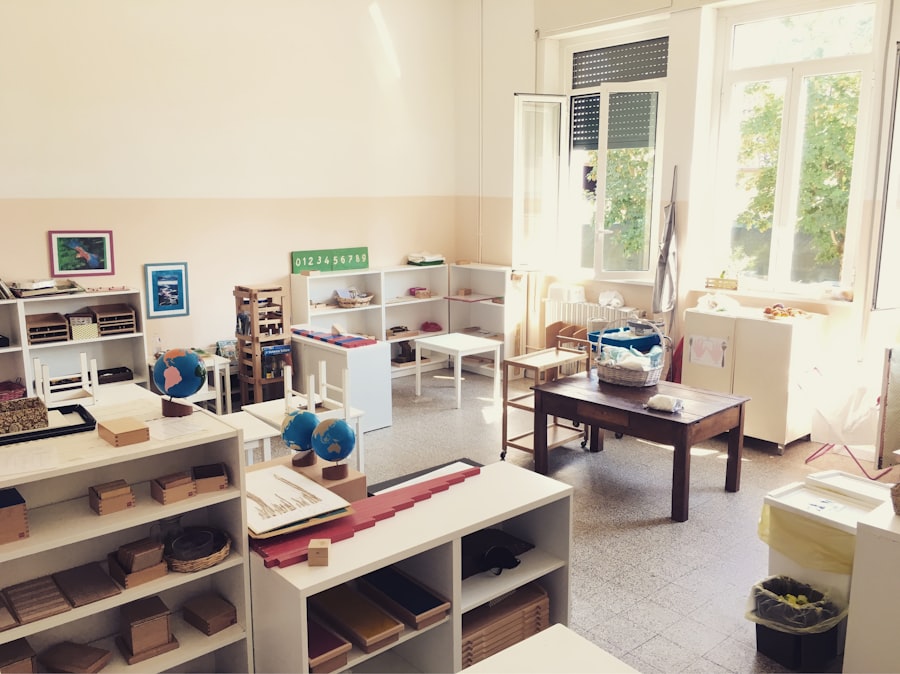
Montessori materials are specifically designed to facilitate hands-on learning experiences that align with developmental stages. These materials are often multi-sensory and promote exploration through manipulation. For instance, the iconic pink tower consists of ten wooden cubes that vary in size; as children build with these cubes, they develop spatial awareness and an understanding of concepts such as size and order.
The intentional design of Montessori materials serves multiple purposes: they engage children’s senses, promote cognitive development, and encourage problem-solving skills. Each material is crafted to isolate specific concepts or skills, allowing children to focus on one aspect at a time without distraction. For example, the bead frame helps children visualize mathematical operations through physical manipulation of beads rather than abstract symbols on paper.
This tactile engagement deepens understanding and retention of knowledge.
Social and Emotional Development in Montessori Education
Montessori education places significant emphasis on social and emotional development alongside academic growth. The classroom environment fosters collaboration and respect among peers, encouraging children to work together on projects or engage in group discussions. This collaborative spirit nurtures essential social skills such as communication, negotiation, and conflict resolution—skills that are vital for success in both personal and professional realms.
Emotional intelligence is also cultivated through the Montessori approach. Children are encouraged to express their feelings openly and learn how to navigate complex emotions in a supportive environment. Teachers guide discussions about emotions and relationships, helping children develop empathy and understanding towards others’ perspectives.
By creating a safe space for emotional expression, Montessori education equips children with the tools they need to build healthy relationships throughout their lives.
The Long-Term Benefits of Montessori Education
The long-term benefits of Montessori education extend far beyond the classroom walls. Research has shown that students who have experienced Montessori education often exhibit higher levels of academic achievement compared to their peers in traditional educational settings. They tend to score higher on standardized tests and demonstrate greater critical thinking skills as they progress through their educational journeys.
Moreover, the skills developed in Montessori environments—such as independence, self-motivation, and social-emotional intelligence—translate into success in adulthood. Many former Montessori students report feeling more prepared for real-world challenges due to their experiences in self-directed learning environments. They often display strong leadership qualities and adaptability in various situations, making them well-equipped for both personal and professional endeavors.
In conclusion, Montessori education offers a holistic approach that nurtures not only academic growth but also social-emotional development and practical life skills. By fostering independence and encouraging self-directed learning within mixed-age classrooms, this method prepares children for lifelong success in an ever-changing world. The carefully designed materials and supportive environment further enhance this transformative educational experience, making Montessori education a compelling choice for families seeking an enriching alternative to traditional schooling methods.